




EC Reflective Mirrors vs. Guest–Host LC Reflective Mirrors
Automotive Smart Anti-Glare Mirror Technology
1. Introduction |
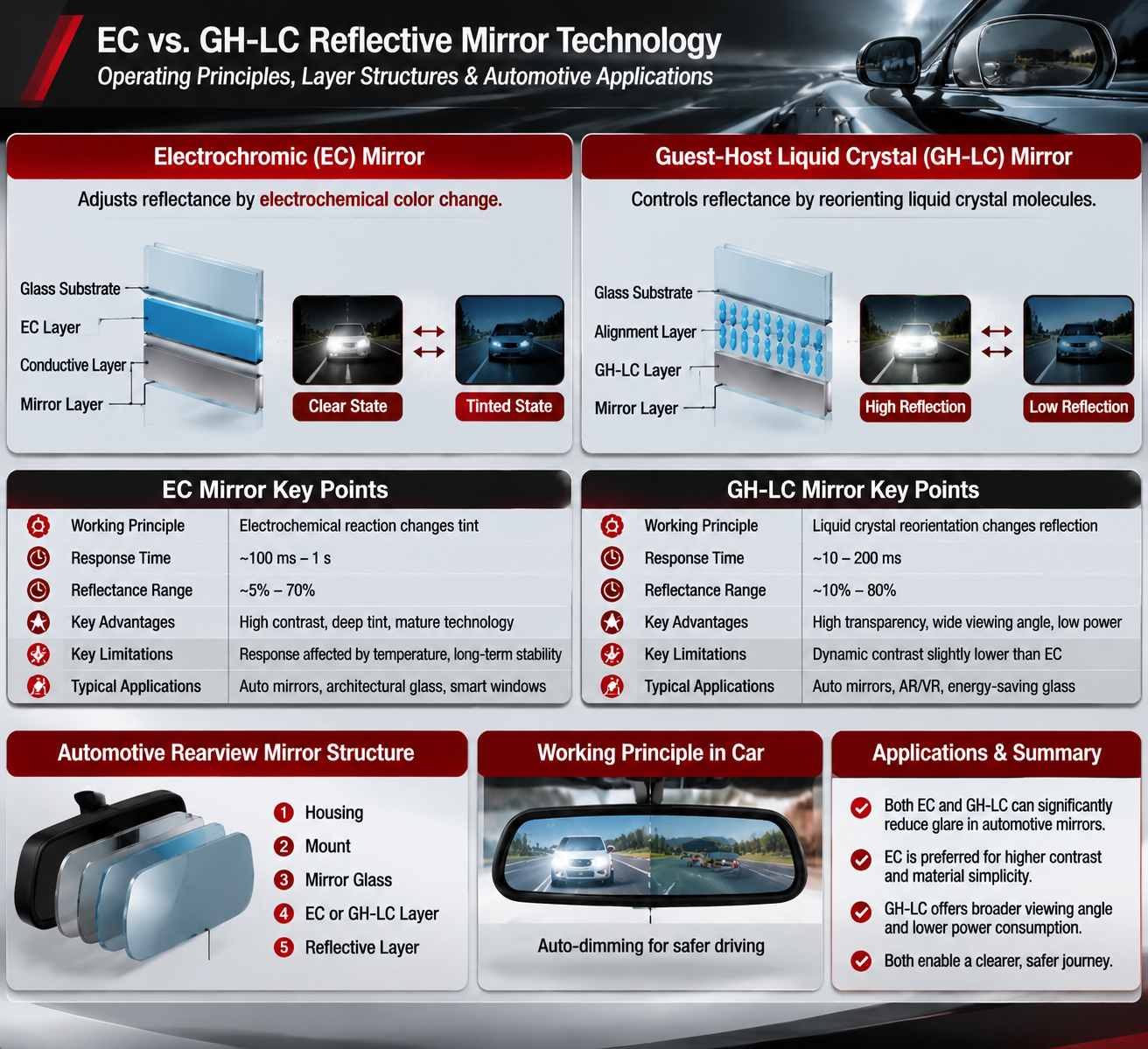
Electrochromic (EC) mirrors and Guest–Host Liquid Crystal (GH-LC) mirrors are two electro-optical technologies capable of dynamically adjusting mirror reflectance. Both technologies can be used to reduce glare from headlights behind a vehicle, improving nighttime driving comfort and visual safety.
However, their operating mechanisms are fundamentally different.
- EC Mirror — Electrochemically controlled optical absorption.
- GH-LC Mirror — Electrically controlled molecular orientation and dichroic absorption.
2. Operating Principles |
2.1 Electrochromic Mirror (EC)
What is electrochromism?
Electrochromism refers to the reversible change in the optical absorption characteristics of a material under an applied electrical potential. This change is generally associated with electrochemical oxidation and reduction reactions. Typical electrochromic materials include tungsten oxide (WO₃), nickel oxide (NiO), and various organic electrochromic compounds. Traditional automotive electrochromic mirrors commonly use solution-based or composite electrochromic media. Viologen-based compounds are examples of organic electrochromic materials used in some electrochemical systems.
How does an EC mirror work?
- ➤ Bleached state: The electrochromic medium remains relatively transparent, allowing high mirror reflectance.
- ➤ Glare detection: A sensor detects excessive light from vehicles behind the car.
- ➤ Voltage application: The control circuit applies an electrical potential to the electrochromic cell.
- ➤ Electrochemical reaction: Ions and electrons participate in reversible electrochemical processes.
- ➤ Coloration: The electrochromic medium becomes darker and absorbs more light.
- ➤ Reflectance reduction: The reflected light reaching the driver’s eyes is reduced.
- ➤ Recovery: When glare disappears, the electrochromic medium gradually returns to its bleached state.
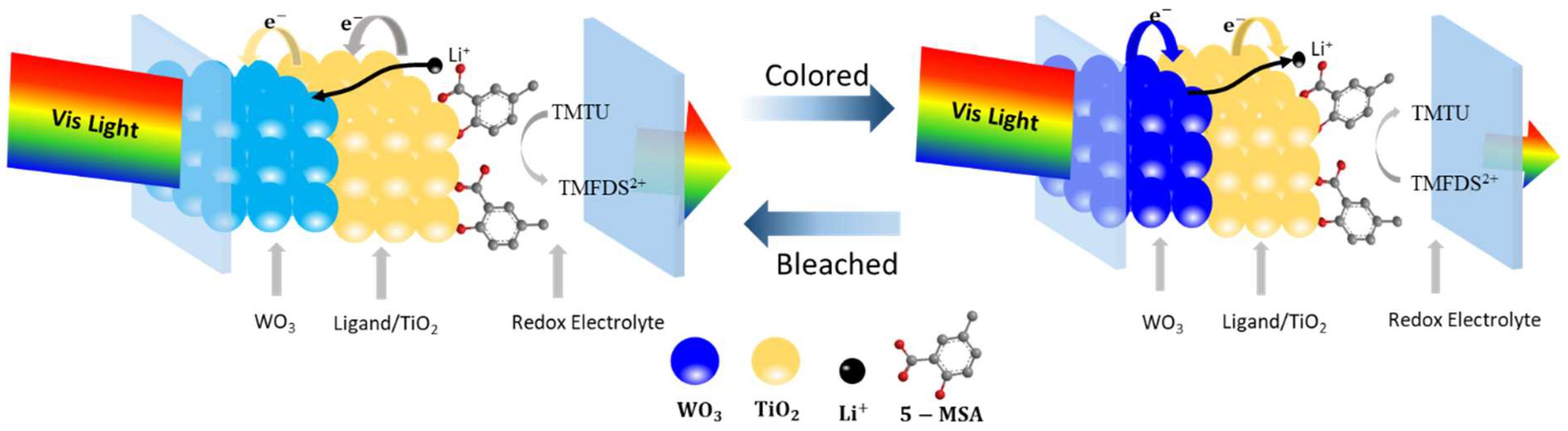
(Figure. Electrochromic coloration and bleaching mechanism.)
2.2 Double-Pass Absorption
In a typical reflective electrochromic mirror, incident light passes through the electrochromic medium before reaching the reflector. After reflection, the light passes through the electrochromic medium again before reaching the observer. This is known as double-pass absorption.
A simplified optical model can be expressed as:
Reff ≈ RmT2EC + Rfront
- Reff : Effective reflectance
- Rm : Reflector reflectance
- TEC : Single-pass transmittance of the EC medium
- Rfront : Front-surface reflection contribution
Actual mirror performance also depends on interface reflections, spectral characteristics, scattering, and multilayer interference.
2.3 Guest–Host Liquid Crystal Mirror (GH-LC)
What is the Guest–Host LC system?
A Guest–Host liquid crystal system consists of dichroic dye molecules dissolved or dispersed in a liquid crystal host. The liquid crystal acts as the Host, while the dichroic dye acts as the Guest. The dye molecules tend to align with the liquid crystal molecules. Dichroic dyes exhibit different light absorption characteristics along different molecular directions. Therefore, changing the liquid crystal orientation changes the absorption of the dye molecules.
How does a GH-LC mirror work?
- ➤ Initial alignment: Liquid crystal molecules adopt an initial orientation determined by the alignment layers.
- ➤ Electric field application: A voltage is applied between transparent electrodes.
- ➤ Molecular reorientation: The liquid crystal molecules change their orientation under the electric field.
- ➤ Dye alignment: The dichroic dye molecules follow the orientation of the liquid crystal host.
- ➤ Absorption modulation: The directional absorption of the dye changes.
- ➤ Reflectance adjustment: The reflected light intensity changes accordingly.
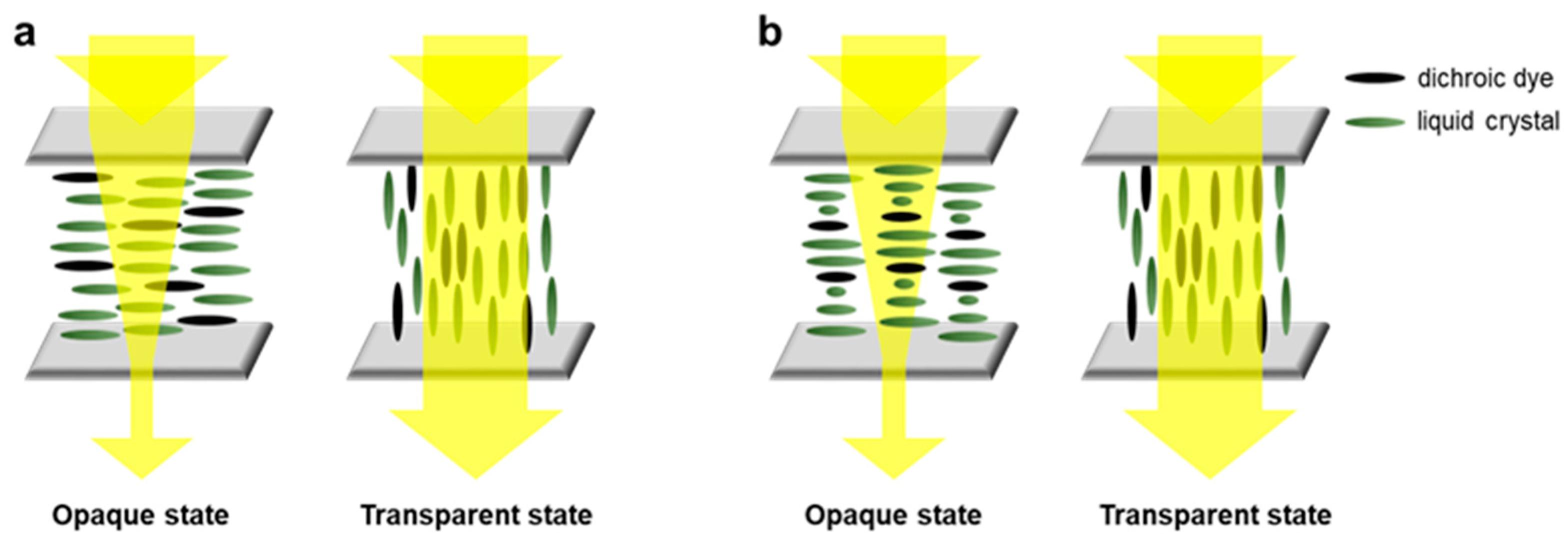
(Figure. Molecular orientation and dichroic absorption in a GH-LC cell.)
2.4 Why Does GH-LC Need a Reflective Layer?
A conventional GH-LC layer primarily controls optical absorption rather than providing high mirror reflectance by itself. A reflective or transflective coating is therefore required to provide the mirror function. A typical structure includes front glass, transparent electrodes, alignment layers, a GH-LC layer, and a reflector. The reflected light passes through the GH-LC layer twice, producing double-pass absorption.
3. Technical Comparison |
3.1 Performance Comparison
| EC Mirror vs GH-LC Mirror | Technical Parameter Comparison | ||
| Technical Parameter 技术参数 |
EC Mirror EC电致变色镜 |
GH-LC Mirror GH-LC全液晶镜 |
| Operating mechanism 工作机制 |
Electrochemical redox 电化学氧化还原 |
Molecular reorientation 分子取向变化 |
| Optical mechanism 光学机制 |
Variable absorption 可变光吸收 |
Dichroic absorption 二色性吸收 |
| Electrolyte 电解质 |
Required in typical solution-based cells 典型溶液型器件需要 |
No conventional EC electrolyte required 不需要传统EC电解质 |
| Transparent electrode 透明电极 |
Usually required 通常需要 |
Usually required 通常需要 |
| Reflector 反射层 |
Required 需要 |
Required 需要 |
| Response speed 响应速度 |
Generally seconds, depending on design 通常为秒级,取决于设计 |
Potentially milliseconds to hundreds of milliseconds 具有达到毫秒至数百毫秒级的潜力 |
| Holding power 保持功耗 |
Generally low after coloration 着色后通常保持功耗较低 |
AC driving or periodic refresh may be required 可能需要交流驱动或周期性刷新 |
| Reflectance adjustment 反射率调节 |
Continuously variable 可连续调节 |
Continuous or multi-level control 可连续或多档调节 |
| Temperature sensitivity 温度敏感性 |
Reaction kinetics and ion transport are affected 反应动力学及离子迁移会受影响 |
Viscosity and molecular response are affected 液晶黏度及分子响应会受到影响 |
| Long-term stability 长期稳定性 |
Electrochemical cycling and sealing are critical 电化学循环及密封是关键 |
Dye stability and alignment are critical 染料稳定性及取向是关键 |
| Manufacturing maturity 制造成熟度 |
Established automotive applications 已有成熟汽车应用 |
Requires further automotive qualification 仍需进一步汽车级验证 |
The response-speed ranges above are general engineering expectations rather than guaranteed specifications for all products. Actual performance depends on material formulation, cell thickness, electrode design, driving waveform, and operating temperature.
3.2 Advantages and Disadvantages
| EC Mirror vs GH-LC Mirror | Advantages & Disadvantages | ||
| Category | EC Mirror | GH-LC Mirror |
| Advantages | • Mature automotive manufacturing technology. • Continuous reflectance adjustment is possible. • Relatively low holding power after reaching the target coloration state. • No conventional polarizer is required in typical automotive EC mirror designs. • Proven applications in automotive interior and exterior mirrors. |
• Potentially faster optical response. • No conventional electrochemical redox coloration process is required. • Segmented electrodes can enable regional dimming. • Flexible control of molecular orientation and absorption. • Potential integration with other liquid crystal optical functions. |
| Disadvantages | • Response speed can decrease significantly at low temperatures. • Bleaching and coloration speeds may be different. • Electrochemical cycling may cause material degradation. • Electrolyte sealing and moisture protection require careful engineering. • Color shifts may affect the natural appearance of reflected objects. |
• Dichroic dye photostability is a major concern. • Large-area molecular alignment requires precise manufacturing control. • Liquid crystal viscosity and response are temperature-dependent. • Ionic contamination and residual DC must be controlled. • Reflector integration and color neutrality require optimization. |
3.3 Which Technology Is Better for Anti-Glare?
Automotive anti-glare performance is not determined by reflectance reduction alone. It also depends on response time, recovery time, spectral characteristics, viewing angle, and nighttime visibility.
| EC vs GH-LC | Evaluation Item Comparison | ||
| Evaluation Item | EC | GH-LC |
| Strong-light suppression | Mature performance | Promising potential |
| Fast glare response | Limited by electrochemical kinetics | Potential advantage |
| Low-temperature operation | Requires optimization | Requires optimization |
| Continuous dimming | Established | Technically feasible |
| Optical clarity | Established automotive experience | Requires further validation |
| Outdoor durability | Established automotive experience | Requires further validation |
Engineering conclusion: EC is currently the safer choice for mass-production automotive mirrors, while GH-LC is an interesting candidate for next-generation dynamic optical control.
4. Application Fields |
4.1 EC Applications
| EC Mirror vs GH-LC Mirror | Applications | |
| EC Mirror Applications | GH-LC Mirror Applications |
| Automotive interior rearview mirrors. | Automotive reflective mirrors. |
| Automotive exterior side mirrors. | Dimmable optical filters. |
| Smart architectural windows. | Reflective liquid crystal displays. |
| Aircraft dimmable windows. | Smart optical shutters. |
| Electro-optical filters and variable-transmission devices. | Electrically controlled light-absorption devices. |
5. Conventional Automotive Mirror Structure |
5.1 EC Automotive Mirror Structure
A conventional electrochromic automotive mirror commonly uses a laminated glass structure containing an electrochromic medium. The mirror assembly consists of optical layers, electrical connections, sensors, a control circuit, and a mechanical housing.
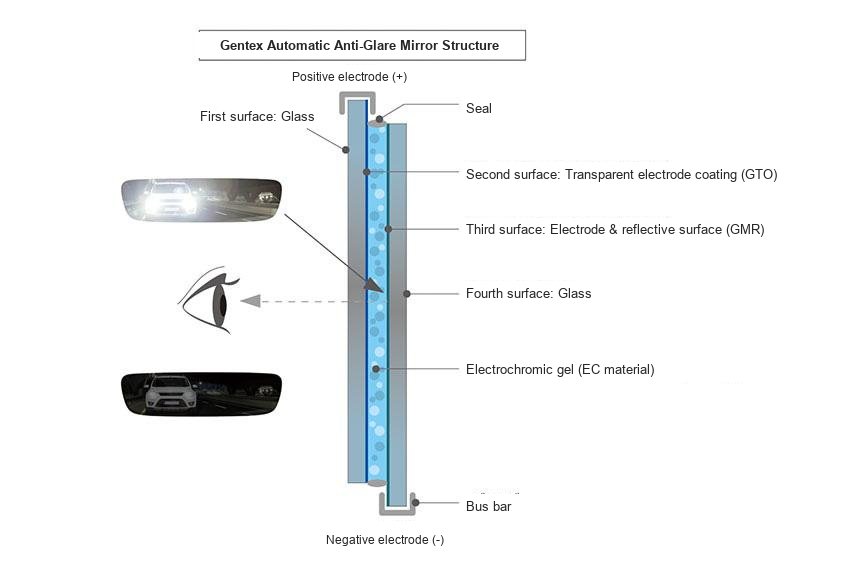
(Figure. Typical EC automotive mirror cross-section.)
| EC Mirror | Layer Structure & Function | ||
| Layer | Component | Function |
| 1 | Front Glass Substrate | Optical protection and viewing window |
| 2 | Transparent Conductive Electrode | Applies electrical potential |
| 3 | Electrochromic Medium | Changes optical absorption |
| 4 | Conductive Reflective Electrode | Provides electrical and reflective functions |
| 5 | Rear Glass Substrate | Mechanical support |
| 6 | Perimeter Seal and Spacer | Maintains cell spacing and prevents leakage |
The exact electrode and reflector arrangement varies among manufacturers and device architectures. Some structures integrate the conductive electrode and reflector into a multifunctional layer.
5.2 EC Mirror System Components
A complete automatic-dimming mirror system contains more than the mirror glass itself.
| EC Mirror | Key Components & Functions | ||
| No. | Component | Main Function |
| 1 | Mirror Element | Reflectance adjustment |
| 2 | Ambient Light Sensor | Measures surrounding light |
| 3 | Rear Glare Sensor | Detects headlights from behind |
| 4 | Electronic Control Unit (ECU) | Calculates dimming requirements |
| 5 | EC Driver Circuit | Controls the EC cell |
| 6 | Vehicle Power Supply | Supplies electrical energy |
| 7 | Mirror Housing | Mechanical protection |
| 8 | Wiring Harness | Electrical connection |
5.3 Automatic Anti-Glare Operation
The automatic anti-glare system compares ambient light and rearward glare signals to determine the appropriate mirror reflectance.
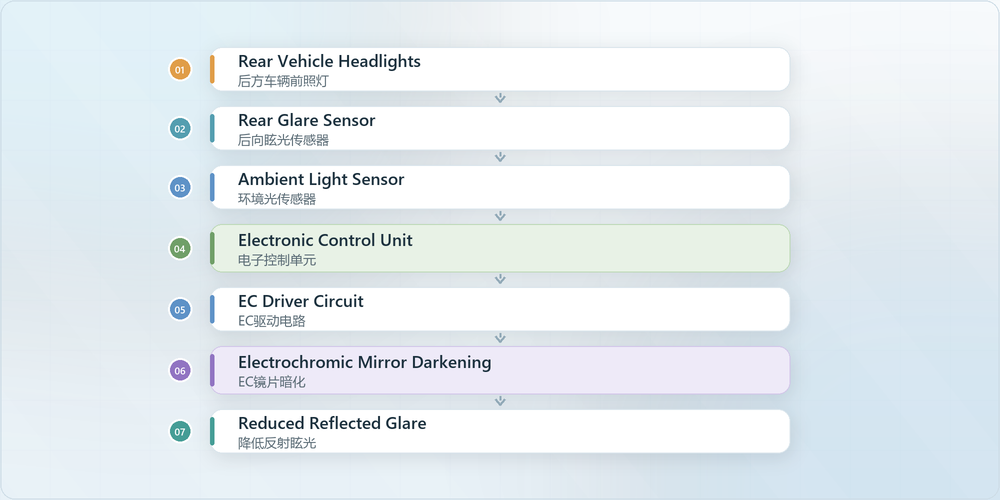
The system does not necessarily switch the mirror to its darkest state whenever strong light is detected. Instead, it calculates the required dimming level according to the ambient lighting conditions and glare intensity.
During daytime driving, high ambient illumination may reduce the need for mirror dimming.
At night, strong headlights from a vehicle behind may trigger automatic dimming.
When the glare disappears, the mirror gradually returns to a brighter state.
5.4 GH-LC Automotive Mirror Structure
A GH-LC automotive mirror uses a liquid crystal cell as its active dimming element. The cell typically contains transparent electrodes, alignment layers, liquid crystal molecules, and dichroic dyes. A separate reflector or transflective layer provides the mirror function.
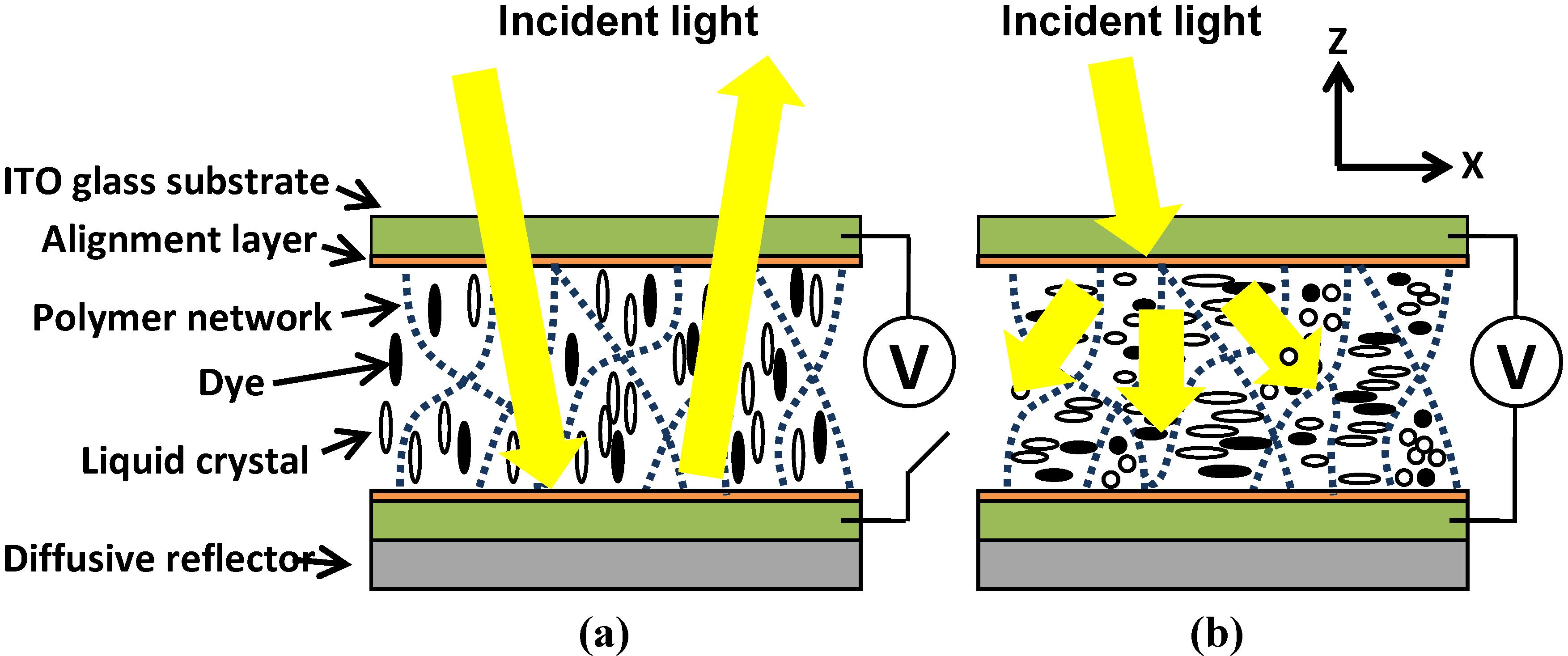
(Figure. Typical GH-LC reflective mirror architecture.)
| GH-LC Mirror | Layer Structure & Function | ||
| Layer | Component | Function |
| 1 | Front Glass | Optical window |
| 2 | ITO Electrode | Creates electric field |
| 3 | Alignment Layer | Controls initial molecular orientation |
| 4 | LC + Dichroic Dye | Modulates optical absorption |
| 5 | Alignment Layer | Controls molecular alignment |
| 6 | ITO Electrode | Completes the electrode structure |
| 7 | Reflective Coating | Provides mirror reflectance |
| 8 | Rear Substrate | Mechanical support |
Different liquid crystal configurations can be considered, including Vertical Alignment (VA) and Twisted Nematic (TN) structures. The optimal configuration depends on the dye dichroic ratio, liquid crystal dielectric anisotropy, cell gap, alignment direction, and target reflectance.
5.5 GH-LC Automatic Dimming Operation
The GH-LC system uses the same general sensor architecture as an EC mirror. However, the active cell is driven by an electric field that changes the molecular orientation.
The driving system generally uses alternating-current waveforms to reduce the risk of ionic migration and residual DC effects.
The driving voltage, frequency, and waveform must be optimized for the specific liquid crystal and dye formulation.
Post time: Nov-19-2026